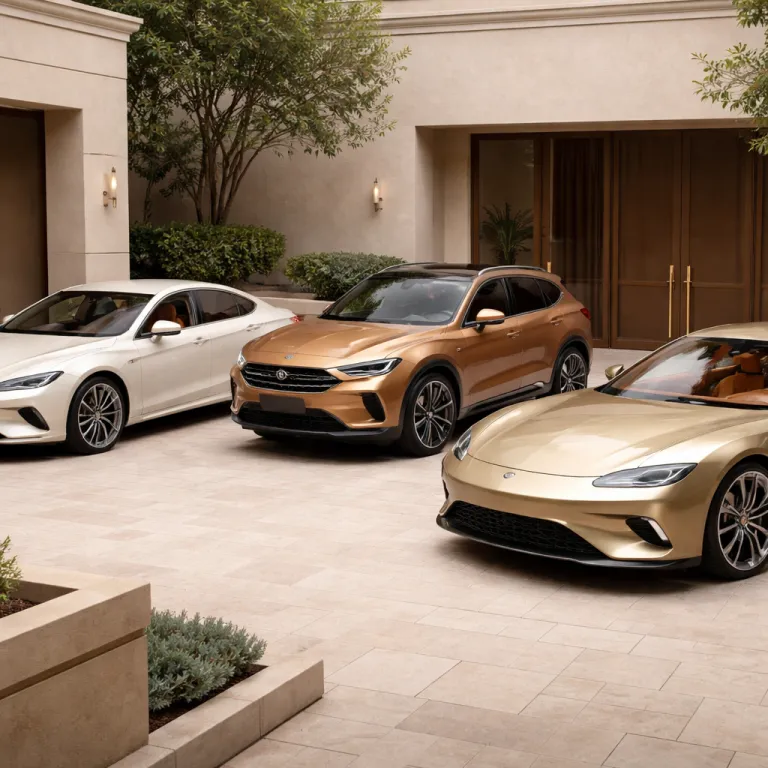
Why this new era of best luxury cars 2026 actually matters
The conversation about the best luxury cars 2026 shoppers should consider has shifted from horsepower bragging to how quietly and intelligently a premium vehicle integrates into daily life. This year the Cadillac Escalade IQ, the Lucid Gravity, and the latest wave of plug-in hybrid sedans best represent a turning point where electric refinement, high-tech cabins, and long-range capability finally meet the expectations of established luxury car owners. In this landscape, the brands that once dominated every luxury ranking now share the stage with newcomers that deliver more than just a badge on the bonnet.
Take the Escalade IQ, often cited on best luxury cars 2026 shortlists for its vast curved display and almost eerie silence at motorway speeds. It reframes what a large luxury SUV flagship can be, pairing a lounge-like cabin with a usable electric range that makes long highway runs feel effortless while still offering the commanding view many SUV buyers demand. For owners used to a traditional Benz or BMW V8, the absence of engine noise is initially disorienting, then deeply addictive once you realise how little fatigue you feel after several hundred miles.
Lucid plays a different game, with the Lucid Air and upcoming Gravity targeting the 2026 luxury conversation through engineering rather than heritage. Their focus on EPA-rated efficiency, ultra-long range, and obsessive aero work means you can cruise at realistic highway speeds while still beating the mpg equivalent of many compact SUVs or even a Lexus hybrid sedan. For a buyer cross-shopping established Mercedes-Benz sedans with these new electric luxury contenders, the question is no longer whether electric works, but whether you still want to pay extra MSRP for a familiar badge when the driving experience has clearly moved on.
Sedan showdown: where the best luxury cars 2026 really separate
Among sedans, the best luxury cars 2026 debate narrows quickly to a handful of serious players that reward ownership rather than just valet presence. The new BMW M5 plug-in hybrid, the latest Porsche Panamera, the Genesis G90, and stalwarts like the Mercedes-Benz E-Class and Lexus ES or LS define the current sedan showdown for any luxury car owner who still values a low seating position and precise steering. Each car offers a different balance of performance, comfort, fuel efficiency, and long-term value, and the rankings only tell half the story.
The BMW M5 plug-in hybrid is the headline act, and rightly so, because it finally aligns brutal acceleration with a conscience about EPA numbers and urban emissions. In electric mode around town, it glides like a discreet luxury limousine, yet when the V8 and electric motors combine, it delivers supercar pace that makes many SUVs feel blunt, while still returning respectable mpg on longer highway stretches. If you care about the best luxury cars 2026 that can do school runs silently, attack a mountain pass, and still feel composed after 800 miles in a weekend, this latest BMW flagship sedan belongs at the top of your personal rankings.
Genesis plays the value card with the G90, undercutting German rivals on MSRP while matching them on leather quality, high-tech features, and base equipment levels. In many comparison tests, the G90 now sits alongside the best luxury sedans from Mercedes and BMW, yet in the real world some owners still hesitate because the dealer network and badge cachet lag behind the established S-Class and other Mercedes-Benz flagships. If you are willing to prioritise craftsmanship, quietness, and generous standard equipment over the last few percentage points of brand recognition, the G90 is one of the cars best positioned to give you that old-school, cocooning luxury feel without the traditional price penalty, much like a well-specced Cadillac CTS did in its prime as a refined modern luxury sedan, which you can see echoed in this analysis of a modern Cadillac CTS luxury sedan.
Electric and hybrid flagships: Lucid, Lexus, and the new mpg reality
For many owners, the best luxury cars 2026 will be the ones that square performance with a credible EPA story and realistic running costs. Electric flagships like the Lucid Air, high-end Lexus hybrid sedans, and plug-in hybrid versions of the Panamera and BMW M5 redefine what mpg means in a segment where fuel economy used to be an afterthought. The question now is not whether a luxury car can be efficient, but how gracefully it balances range, charging or refuelling time, and the kind of effortless torque that makes long trips feel shorter.
The Lucid Air sits at the sharp end of this shift, with some trims offering EPA-rated range figures that embarrass many compact SUVs and even some economy cars, while still delivering the cabin ambience expected from the best luxury four-door flagships. Its official ratings are not just marketing numbers; in mixed driving at realistic highway speeds, owners routinely report consumption that aligns closely with the published data, which is not always the case for traditional performance sedans. If you are used to a Mercedes-Benz or BMW saloon and you value silent thrust more than exhaust theatrics, the Lucid Air deserves a serious view as a primary car rather than a tech toy.
Lexus and Acura approach the same problem differently, with Lexus hybrid systems and the Acura Integra performance hatch offering a bridge for owners not yet ready to go fully electric. A Lexus hybrid sedan or luxury compact SUV will not match the Lucid Air for outright range, but it will deliver consistently strong mpg, low running costs, and the kind of reliability that keeps resale values high after many years and hundreds of thousands of miles. If you want a sharper driving experience, the Acura Integra and related Acura sedans bring a more engaging chassis, and as this review of a modern sports sedan for connoisseurs shows, the Japanese brands still understand how to blend precision steering, compact dimensions, and everyday usability in ways that many larger luxury cars have forgotten.
Luxury SUVs versus sedans: choosing the right format for your life
When you narrow the field of best luxury cars 2026 candidates, the real decision often becomes sedan versus SUV rather than brand versus brand. Luxury SUVs now offer such refined cabins, strong mpg for their size, and impressive highway stability that many traditional sedan loyalists have quietly migrated upwards for the commanding view and easier access. Yet the best four-door models still deliver a level of agility, steering feel, and low-slung elegance that even the most athletic compact crossovers cannot fully replicate.
If you prioritise space, family practicality, and all-weather confidence, the latest luxury SUVs from BMW, Mercedes-Benz, Genesis, and Lexus make a strong case. A well-specced BMW X5 or BMW-based SUV, a Mercedes-Benz GLE, or a Genesis GV80 offers a blend of high-tech interiors, long stretches between fuel stops, and respectable EPA ratings that would have been unthinkable for SUV contenders a decade ago. For many owners, the ability to carry four adults, luggage, and still enjoy a quiet, composed ride at autobahn speeds makes these vehicles best suited to real-world use, even if they sacrifice a little of the intimacy you get from a lower, lighter luxury compact sedan.
Sedan loyalists, however, will point to the way a Panamera, a Lucid Air, or a Genesis G90 flows down a challenging road, using its lower centre of gravity to deliver a more natural rhythm through a series of bends. If you care about how a luxury car feels in that third corner on a wet Alpine pass, rather than just how it looks in the driveway, the best luxury sedans still have an edge over even the most athletic luxury SUVs. For those who want the visual drama of a big SUV without losing that sense of connection, it is worth revisiting earlier icons like the Escalade, as explored in this piece on an elevated Cadillac Escalade driving experience, and then comparing how far the new Escalade IQ has moved the game on in refinement, range, and high-tech integration.
Value, msrp, and resale: paying for substance, not just the badge
For a seasoned owner, the best luxury cars 2026 are not simply the fastest or most lavish, but the ones that make financial sense over a five- to seven-year horizon. That means looking beyond headline MSRP figures to base equipment levels, realistic mpg or electric efficiency, and how well each luxury car holds its value in the used market. Industry resale studies indicate that brands like Tesla, Lexus, Acura, Porsche, and Audi have historically retained more than sixty percent of their value after seven years, which changes the real cost of ownership compared with some traditional luxury cars that depreciate more steeply.
Genesis has made huge strides in this area, offering generous base specifications, long warranties, and interiors that feel every bit as special as many Mercedes-Benz or BMW rivals, yet the brand still faces a perception gap in some surveys. In practice, a Genesis G90 or GV80 can deliver an ownership experience that feels firmly in the top luxury bracket, with high-tech features, quiet cabins, and strong efficiency for their size, but some buyers still worry about dealer coverage and long-term resale. If you plan to keep the car for many miles and value the day-to-day experience more than the logo on the steering wheel, Genesis belongs on any serious list of models suited to pragmatic luxury buyers.
On the other hand, certain Mercedes-Benz and BMW models continue to command strong resale purely because of brand equity, even when their mpg, base equipment, or infotainment feel a step behind the latest competition. That does not make them poor choices, but it does mean you should interrogate whether you are paying for engineering or for heritage when you compare MSRP figures across the 2026 luxury field. The smartest move is to treat rankings as a starting point, then drive the short list back to back, paying attention not just to acceleration or highway refinement, but to how the cabin materials, high-tech interfaces, and overall sense of solidity feel after an hour behind the wheel.
Models to prioritise and models to skip in the best luxury cars 2026 race
When you filter the noise, a clear pattern emerges in the best luxury cars 2026 landscape, separating genuinely advanced models from those trading on last decade’s reputation. Cars like the BMW M5 plug-in hybrid, Lucid Air, Genesis G90, Porsche Panamera hybrids, and Cadillac Escalade IQ represent meaningful progress in performance, efficiency, and high-tech integration. By contrast, some ageing Mercedes-Benz and BMW derivatives, along with certain luxury compact and small SUV spin-offs, feel more like marketing exercises than true advances for the discerning luxury car owner.
The models to prioritise share three traits: they offer a clear technical step forward, they feel cohesive in everyday use, and they justify their MSRP with either exceptional performance or long-term value. The Lucid Air and Escalade IQ push electric range and cabin technology into new territory, while the M5 plug-in hybrid and Panamera hybrids prove that sedans suited to enthusiastic drivers can also deliver respectable EPA efficiency and usable mpg. Genesis G90 and GV80, meanwhile, show that cars best known for value can now compete directly with Mercedes-Benz and BMW on craftsmanship, leaving only badge perception and dealer reach as remaining gaps.
On the skip list, you will find certain luxury compact crossovers and older SUV models that have received only light facelifts while rivals moved to new platforms with better mpg, more advanced safety systems, and cleaner high-tech interfaces. Some entry-level Mercedes-Benz sedans and compact SUVs, for example, carry premium MSRP figures but feel less special inside than a well-specced Acura Integra or Lexus hybrid hatchback, especially once you factor in equipment levels and real-world consumption. In a market where 2026 luxury buyers can choose from such a rich mix of sedans, SUVs, plug-in hybrid flagships, and long-range electric cars, there is little reason to settle for a vehicle that looks the part but feels a generation behind when you actually drive it.
How to build your personal rankings of the best luxury cars 2026
The most effective way to cut through marketing is to create your own rankings of the best luxury cars 2026 based on how you actually live, not how you imagine you drive. Start by listing your non-negotiables: seating position, preferred body style, minimum range or mpg, and the kind of highway refinement you expect from a true luxury car. Then map those needs against a short list that includes at least one sedan, one SUV, and one plug-in hybrid or full electric option from brands like BMW, Mercedes-Benz, Genesis, Lexus, Acura, and Lucid.
During test drives, pay close attention to details that spec sheets and comparison tables cannot capture, such as pedal feel, steering weight, seat comfort after an hour, and how intuitive the high-tech interfaces feel when you are tired. A car like the Lucid Air may wow you with its EPA range and minimalist cabin, while a more traditional Mercedes-Benz sedan might feel instantly familiar, and a Genesis G90 could surprise you with its hushed refinement and generous base equipment. The goal is to identify which models best align with your instincts, because the right luxury car should feel like an extension of your preferences rather than a compromise you rationalise later.
Finally, consider the ownership ecosystem around each contender, including dealer proximity, service reputation, and the availability of loan cars or pick-up services, especially for high-end sedans suited to busy professionals. A slightly lower MSRP or marginally better mpg figure can be outweighed by poor service experiences over many years and many thousands of miles, while a brand with a strong support network can make even a complex plug-in hybrid or high-tech electric flagship feel effortless to own. In the end, the best luxury cars 2026 for you will not be defined by a single rankings table, but by how confidently you look back at your car in the car park, knowing you chose it for the right reasons rather than the loudest marketing message.
Key figures shaping the modern luxury car market
- Independent resale data from multiple market analysts shows that brands such as Tesla, Lexus, Acura, Porsche, and Audi typically retain more than 60% of their original value after seven years, which significantly lowers effective ownership cost compared with luxury cars that depreciate faster.
- Recent electric luxury flagships like the Lucid Air offer EPA-rated range figures exceeding 400 miles (around 650 km) on certain trims, giving them more real-world motorway flexibility than many earlier-generation electric cars and even some high-performance petrol sedans.
- Modern plug-in hybrid performance sedans such as the latest BMW M5 can deliver combined system outputs above 700 horsepower while still achieving substantially better mpg and lower emissions than their purely combustion predecessors, especially in urban driving.
- Large electric luxury SUVs like the Cadillac Escalade IQ now integrate curved displays of more than 55 inches in width, turning the cabin into a digital lounge and setting new expectations for in-car tech experiences in the premium segment.
- Residual value studies across major European markets indicate that well-specified Genesis G90 and GV80 models are closing the gap to comparable Mercedes-Benz and BMW rivals, reflecting growing acceptance of the brand among used luxury car buyers.
Frequently asked questions about choosing the best luxury cars 2026
Are electric luxury sedans now a better choice than petrol models for long trips?
For many owners, modern electric luxury sedans like the Lucid Air now offer enough range, fast-charging capability, and highway refinement to rival or surpass traditional petrol sedans on long journeys, provided you have reliable access to high-speed chargers along your usual routes.
How should I compare msrp figures between different luxury brands fairly?
The fairest way to compare MSRP is to look at similarly equipped cars, focusing on base equipment, key options such as driver assistance and audio, and expected resale value after five to seven years, rather than just the headline starting price.
Do luxury suvs really offer worse mpg than modern sedans?
While larger luxury SUVs still tend to consume more fuel than equivalent sedans because of weight and aerodynamics, recent models with efficient engines, mild hybrids, or plug-in hybrid systems have narrowed the gap significantly, especially on steady highway runs.
Is Genesis now a genuine alternative to Mercedes Benz and BMW in the luxury segment?
Genesis has reached a point where its top models match or exceed many Mercedes-Benz and BMW rivals on interior quality, refinement, and high-tech features, though some buyers may still weigh dealer network size and brand prestige before switching.
What matters more in a luxury car purchase, performance or long term comfort?
For most owners, long-term comfort, refinement, and ease of use matter more day to day than outright performance, so it is wise to prioritise seating, noise levels, and control ergonomics over maximum acceleration when choosing among the best luxury cars 2026 candidates.